
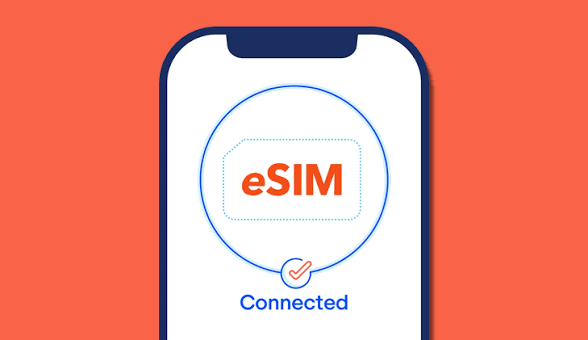
You land in Jakarta or Bali, phone in hand, and the first thing you need before anything else (before the hotel, before food, before figuring out which side of the road people drive on) is internet. For years, that meant hunting down a SIM card counter at the airport, digging through your bag for a SIM ejector pin, and hoping the staff spoke enough English to sell you the right plan. eSIM has quietly made all of that unnecessary.
If you’re a digital nomad weighing your options for staying connected in Indonesia, here’s what eSIM actually offers, and where it fits alongside things like portable WiFi.
An eSIM is a digital SIM card built directly into your phone or tablet. Instead of popping in a physical chip, you scan a QR code or install a profile, and your device is online within minutes. No plastic card, no ejector pin, no risk of losing a tiny SIM tray piece somewhere between the airport and your hotel.
Most phones released in the last few years support eSIM, including recent iPhones, Google Pixels, and many Samsung Galaxy models. It’s worth double checking your specific phone model before you fly, just so there are no surprises when you land.
Here’s the thing about being a digital nomad: your internet needs aren’t the same as a tourist’s. A tourist checks Google Maps and posts a few photos. A nomad is on client calls, uploading deliverables, joining team standups at odd hours, and needs internet the moment they touch down, not two hours later after standing in an airport queue.
A few reasons eSIM tends to fit that lifestyle well:
You can activate it before you even leave home. Buy it online, install the profile while you’re still packing, and by the time you land, you just switch it on. No scrambling for a local SIM shop with a jetlagged brain.
It keeps your original number active alongside it. Most phones support dual SIM setups, so you can keep your home number for banking apps and two-factor authentication while using the local eSIM for data.
No physical card to lose. If you’re someone who’s already lost a passport once (no judgment) or misplaced a hotel key card within the first hour of check-in, not having a tiny removable SIM to keep track of is genuinely one less thing to worry about.
Switching between countries is faster. Hopping from Bali to Bangkok to Kuala Lumpur on a nomad circuit? You’re not standing in another SIM counter queue every time you cross a border.
If you’re specifically looking at Indonesia, PinjamWiFi also offers an Indonesia eSIM built with exactly this kind of traveler in mind, and it’s worth mentioning a few things that actually matter in day to day use, not just on paper.
Tethering is allowed. This sounds like a small detail until you actually need it. Some eSIM providers quietly block hotspot sharing, which is a problem the moment you want to connect your laptop for a client call while your phone handles notifications on the side. PinjamWiFi’s eSIM lets you tether normally, so your phone essentially doubles as your personal hotspot.
It automatically finds the best signal. Indonesia isn’t one uniform network. Coverage quality shifts depending on which operator has better infrastructure in a given area, whether you’re in central Seminyak or somewhere further out in Ubud or Uluwatu. Rather than locking you to a single carrier, the eSIM connects across multiple operators and automatically picks up whichever signal is strongest in your current location. Practically, that means fewer dead zones and less manually fiddling with network settings when you move around the island.
It’s actually affordable. Plans start from around Rp30,000, which is a low enough entry point that you don’t need to think too hard before buying one, especially if you’re only staying for a short trip or just want a backup data option alongside your main plan.
Short answer: they solve slightly different problems, and a lot of nomads end up using both depending on the situation.
An eSIM lives on your phone and covers you personally, wherever you go, as long as there’s signal. It’s ideal for solo travel, quick trips, or as your main connection when you’re moving around a lot.
Portable WiFi, on the other hand, is a separate device you carry that can connect multiple gadgets at once. It’s the better call if you’re traveling with a partner or small team, working from a laptop most of the day, or want a dedicated backup in case your accommodation’s WiFi goes down mid meeting.
Honestly, plenty of experienced nomads carry both: an eSIM as their everyday personal connection, and a portable WiFi device as backup for heavier work sessions or when splitting connectivity across a group.
Setting up an eSIM is refreshingly simple:
That’s really it. No queueing, no paperwork, no language barrier at a counter.
For digital nomads in Indonesia, eSIM removes a lot of the friction that used to come with staying connected in a new country. You land, you’re online, and you don’t lose half a travel day sorting it out. With options like PinjamWiFi’s Indonesia eSIM offering tethering support, automatic multi-operator signal switching, and plans starting from just Rp30,000, it’s a low-risk way to stay connected without overcomplicating your setup, whether it’s your main connection or just a reliable backup for when you need it most.




All credit card payments are processed by DOKU. Payments can also be made by Bank Transfer.
Main Office
Jakarta:
Monday – Sunday 08.00-16.00
Jl. Petojo VIY II No.49RT.7/RW.6, Petojo Utara, Kecamatan Gambir, Kota Jakarta Pusat, Daerah Khusus Ibukota Jakarta 10150
Branches
Bali:
Monday – Friday 09.00-17.00
Jl. Raya Kuta No.129, Kuta, Kec. Kuta, Kabupaten Badung, Bali 80361 (1 gedung dengan Martha Tilaar SPA) Pinjam Wifi di lantai 3.
Bandung:
(online) Setiabudi
Medan:
(online) Medan Tembung, Medan, Sumatera Utara
Pekanbaru:
(online) Tampan, Payung Sekaki Pekanbaru, Riau 28292
©2023 Pinjam WiFi. All rights reserved. Website Design by Alamaya
