
Most people assume they’ll be fine relying on their hotel’s WiFi during a Bali trip. Check in, connect, done. Except that’s not really how a Bali itinerary works. One day you’re at a beach club in Uluwatu, the next you’re hiking through rice terraces in Ubud, then you’re on a boat to Nusa Penida with zero signal for half the day. Hotel WiFi covers exactly one location: your hotel. Everywhere else, you’re on your own.
So if you’re planning a trip and trying to figure out how to actually stay connected, here’s an honest breakdown of your three main options, and when each one makes sense.
This is the default a lot of travelers fall back on, mostly because it feels free. And to be fair, it works fine if your trip is genuinely simple: one hotel, minimal movement, no urgent need to be online outside of it.
The problems start the moment your itinerary gets more ambitious, which, let’s be honest, it usually does in Bali. You’ll want internet while:
None of that works if your only internet lives back at the hotel. On top of that, public WiFi in busy tourist areas gets congested fast, especially during peak season when half the café is on a Zoom call and the other half is uploading Instagram stories.
Bottom line: fine as a backup, risky as your only plan.
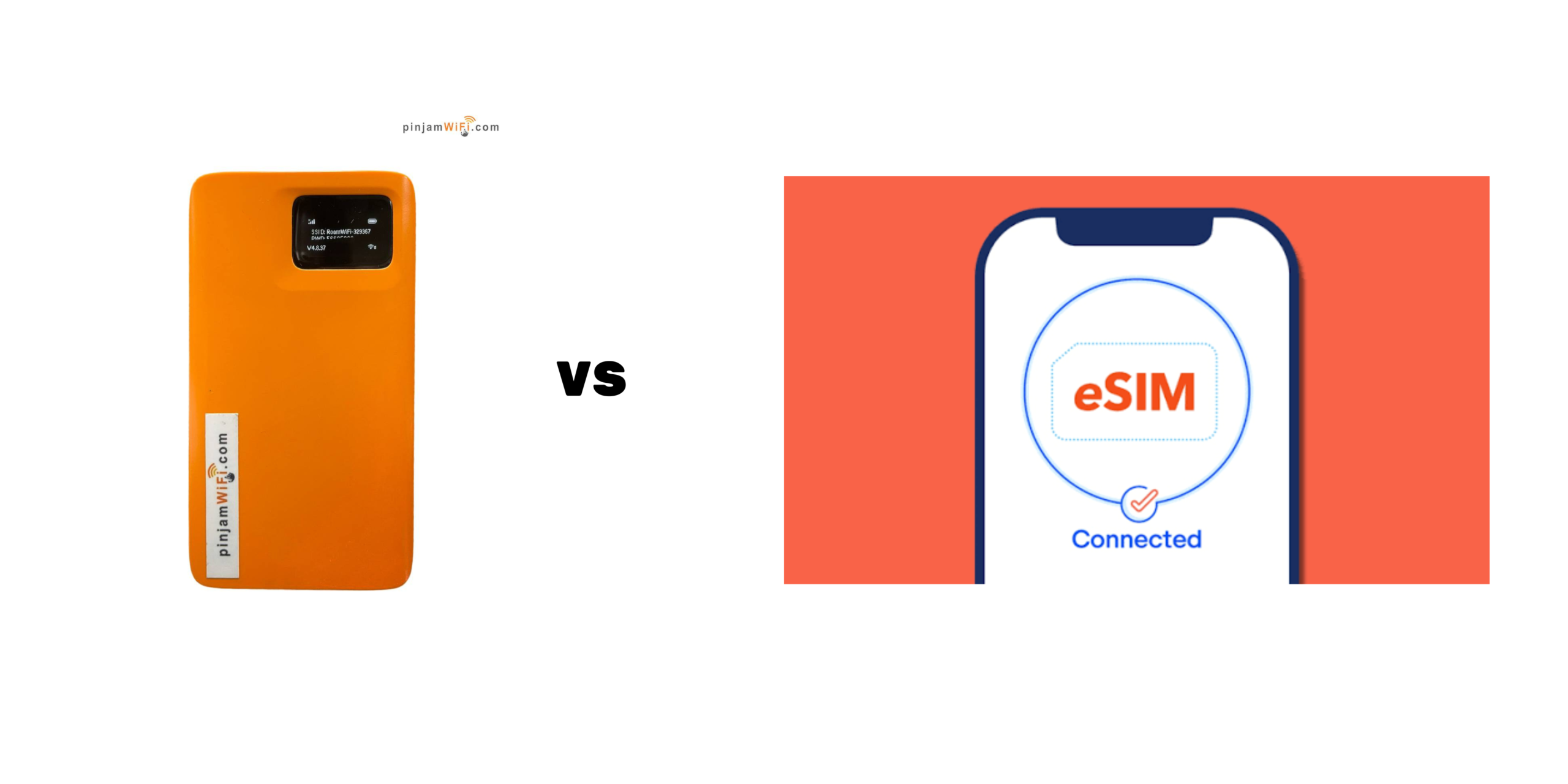
An eSIM is a digital SIM card you install on your phone before you even land, usually while you’re still connected to WiFi at home. No physical card, no SIM shop counter, no ejector pin. You touch down, switch it on, and you’re online.
This is genuinely one of the most convenient options for solo travelers or couples who mainly need internet on their phones. PinjamWiFi’s Indonesia eSIM, for example, supports tethering, so your phone can double as a hotspot if you need to get a laptop online too. It also automatically searches across multiple operators to lock onto whichever signal is strongest wherever you are, which matters more than people expect since coverage quality genuinely shifts depending on the area you’re in. And with plans starting from around Rp30,000, it’s cheap enough to just grab one without overthinking it.
Where it falls short: if you’re traveling with family or a small group, everyone needs their own eSIM, or you’re stuck sharing one phone’s hotspot with a battery that’s draining fast.
A portable WiFi device is a small router you carry with you that creates its own WiFi network wherever you go. Instead of connecting one phone, it connects multiple devices at once, laptops, tablets, everyone’s phones, all sharing the same connection.
This is the better call for:
PinjamWiFi’s portable WiFi rentals start from as little as 3 days, with truly unlimited quota (no quiet throttling after a certain amount of data), a battery that lasts around 12 hours, and support for up to 5 connected devices at once. You can either swing by their Bali office to pick one up yourself, or have it delivered straight to your villa or hotel through Grab Instant if you’d rather not deal with logistics right after a long flight.
Here’s a simple way to think about it:
Solo traveler or couple, moving around a lot, mainly need your phone online? Go with an eSIM. It’s cheap, fast to set up, and covers your personal device without extra hardware to carry.
Traveling with family, a group of friends, or need multiple devices connected at once? Portable WiFi makes more sense. One device, shared connection, no one stuck without data.
Working remotely or planning a longer stay? Honestly, a lot of people end up using both: an eSIM for everyday personal use on the go, and a portable WiFi device as a dedicated, reliable connection for work sessions or as backup when accommodation WiFi isn’t cutting it.
Just relying on hotel WiFi and hoping for the best? Fine for a short, low-key trip. Risky for anything involving day trips, group travel, or actual work.
There’s no single “correct” answer here, it really depends on how your trip is shaped. But the one thing worth avoiding is landing in Bali with no backup plan and assuming WiFi will just be there when you need it. Between an affordable eSIM and a reliable portable WiFi option, both available through PinjamWiFi with pickup or Grab Instant delivery in Bali, there’s a low-effort way to stay connected no matter how your itinerary shifts once you’re actually on the island.




All credit card payments are processed by DOKU. Payments can also be made by Bank Transfer.
Main Office
Jakarta:
Monday – Sunday 08.00-16.00
Jl. Petojo VIY II No.49RT.7/RW.6, Petojo Utara, Kecamatan Gambir, Kota Jakarta Pusat, Daerah Khusus Ibukota Jakarta 10150
Branches
Bali:
Monday – Friday 09.00-17.00
Jl. Raya Kuta No.129, Kuta, Kec. Kuta, Kabupaten Badung, Bali 80361 (1 gedung dengan Martha Tilaar SPA) Pinjam Wifi di lantai 3.
Bandung:
(online) Setiabudi
Medan:
(online) Medan Tembung, Medan, Sumatera Utara
Pekanbaru:
(online) Tampan, Payung Sekaki Pekanbaru, Riau 28292
©2023 Pinjam WiFi. All rights reserved. Website Design by Alamaya
